
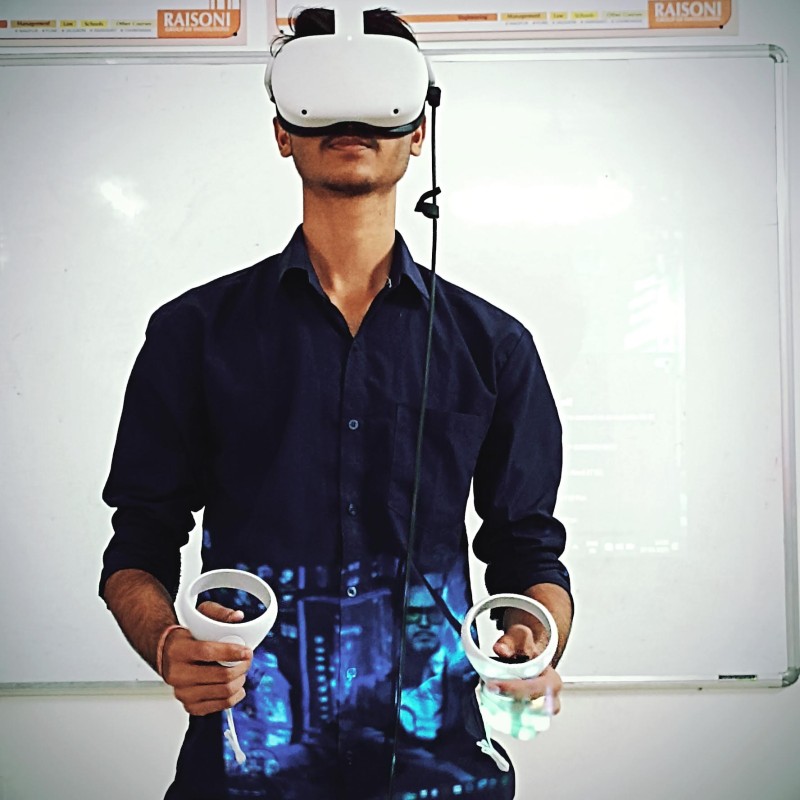
.png)
"A student who walks through a virtual human heart never forgets how blood flows. A student who reads about it in a textbook — often does."
We are living through the most exciting shift in education since the printing press. Augmented Reality (AR), Virtual Reality (VR), and Mixed Reality (MR) — collectively called Extended Reality (XR) — are no longer the stuff of science fiction or expensive university research labs. They are being deployed in schools and colleges across Pune, Maharashtra, and India right now, and the results are extraordinary.
If you are a school principal, college dean, administrator, or educator asking "How do I boost admissions?" or "How do I make chemistry, physics, biology, history, or engineering genuinely exciting for my students?" — this article is for you.
1. What Is XR? AR, VR & MR Explained Simply
Before diving into benefits, let's get the terminology straight — because these three terms are often confused:
Virtual Reality (VR)
Fully immerses the user in a computer-generated 3D world. Requires a headset. The physical world disappears.
Augmented Reality (AR)
Overlays digital content onto the real world via a phone, tablet, or AR glasses. The physical world stays visible.
Mixed Reality (MR)
Blends real and virtual worlds so that physical and digital objects interact in real time. The most advanced form.
Together, these are called Extended Reality (XR) — and when combined with Artificial Intelligence (AI), they create adaptive, personalised learning environments that respond to each student's pace, knowledge level, and learning style.
2. How AR & VR Increases School & College Admissions
The question every school principal and college admission team is asking: "How do we attract more students in a competitive landscape?" The answer, increasingly, is immersive technology.
🎯 Virtual Campus Tours That Wow Prospects
Imagine a prospective student in Nagpur or Delhi — or even in Dubai or London — putting on a VR headset and walking through your campus, entering your labs, and sitting in your classrooms, all without traveling. VR-powered virtual campus tours increase enrolment interest by removing geographical barriers and making the experience memorable and visceral.
🏆 Differentiation: Stand Out from Every Other Institution
When a student and their parents attend an open day and see students actively using VR headsets to explore 3D molecular structures or virtually dissecting a frog — the impression is instant and lasting. The message is clear: "This institution invests in the future of learning." That emotional resonance converts inquiries into admissions.
Institutions that openly showcase XR technology in their marketing materials and open days consistently report 25–40% higher inquiry-to-admission conversion rates compared to those relying solely on traditional brochures and presentations.
📣 Powerful Marketing Content
A 30-second video of students fully immersed in VR headsets, laughing and exclaiming in wonder, is one of the most shareable forms of educational marketing. It travels on Instagram, YouTube, and LinkedIn far further than any admission pamphlet ever could. This organic reach drives inbound inquiries at near-zero cost.
🤝 Parent Confidence & Trust
Parents in India are deeply invested in their children's educational future. When they see an institution using cutting-edge XR and AI technology, they associate it with a progressive, future-ready education. This trust directly translates into enrollment decisions — particularly at the school level, where parent opinion drives choice.
📊 AR-Powered Admission Events
Schools and colleges can use AR-enabled brochures and posters — print materials that, when scanned with a phone, spring to life with 3D animations, video testimonials, and interactive campus maps. This transforms mundane admission collateral into an immersive brand experience.
3. Teaching Difficult & Complex Concepts Easily with Immersive Tech
This is arguably the most profound academic benefit of XR technology. Every educator knows the frustration: you have explained the Krebs cycle, electromagnetic induction, or the French Revolution six different ways, and yet students still struggle to internalise it. The problem is not the student — it is the medium.
🔬 Science: Making the Invisible Visible
In biology, students can shrink to the size of a blood cell and travel through the circulatory system. In chemistry, molecular bonds become giant 3D structures students can walk around, rotate, and break apart. In physics, they can witness Newtonian mechanics by throwing virtual objects on the moon versus on Earth. These are concepts that no 2D diagram can convey with the same clarity.
⚗️ Safe Lab Experiments Without the Risk or Cost
Dangerous chemistry experiments, expensive equipment, limited lab time — VR solves all three simultaneously. Students can conduct infinite iterations of a titration experiment, a dissection, or an electrical circuit assembly in a virtual lab without consuming materials, without risk of injury, and available 24/7 from their home.
🏛️ History & Social Science: Experience, Not Memorise
Instead of reading about the Indus Valley Civilisation, students can walk through a virtual Mohenjo-daro. Instead of memorising dates of World War II, they experience key moments as an immersive 360° narrative. Emotional engagement with historical events dramatically increases retention and critical thinking.
🔧 Engineering & Vocational Training
For engineering students, AR can overlay 3D exploded-view diagrams onto a real engine or circuit board, turning a physical object into an interactive learning tool. Vocational students — from welding to electrical work — can practise dangerous or expensive procedures in VR until they are fully competent, before ever touching the real thing.
♟️ Maths: Spatial Understanding Through 3D Geometry
Abstract mathematical concepts like 3D geometry, calculus curves, or probability distributions become tangible when students can interact with them spatially. Research consistently shows that spatial learning improves mathematical performance — and XR is the most powerful spatial learning tool ever created.
3D anatomy, cell processes, surgical training in VR
Mechanics, circuits, structural analysis in real-time 3D
Virtual field trips, historical reconstructions, tectonic plates in motion
Virtual labs, molecular interaction visualisation, safe reaction modelling
3D geometry, calculus surfaces, statistics as living data
Walk through buildings before they are built. Real-scale spatial design.
4. Top Benefits of AR/VR in Education
The XR Learning Advantage
Immersive, experiential learning powered by AR, VR, and AI doesn't just improve engagement — it fundamentally changes how deeply and how durably knowledge is encoded in the brain. Every benefit below is backed by educational neuroscience and real-world deployments.
1. Dramatically Higher Retention Rates: The Learning Pyramid model shows that students retain approximately 5% of what they hear in a lecture, 10% of what they read, but up to 75% of what they practice by doing. XR creates an immersive "doing" environment that activates multiple sensory pathways simultaneously, anchoring memories far more durably than passive study.
2. Personalised Learning at Each Student's Pace: When combined with AI, XR platforms can detect a student's comprehension level in real time and dynamically adjust the difficulty, pacing, hints, and visual representations. A student struggling with orbital geometry gets a different VR experience to one who has already mastered it.
3. Engagement for Students Who Struggle with Traditional Methods: Not every learner thrives in a traditional lecture-and-textbook environment. Kinaesthetic and visual learners — who represent a large proportion of struggling students — often excel in immersive XR environments. Schools report significant reductions in disengagement and disciplinary issues when XR is introduced.
4. Global Virtual Field Trips Without a Budget: Every school in India can take its students to the Louvre, the Amazon rainforest, the surface of Mars, or inside CERN's Large Hadron Collider — all without a single rupee spent on transport or accommodation. This radically democratises access to world-class educational experiences, regardless of whether a school is in Mumbai or a small town in rural Maharashtra.
5. Reduced Equipment and Lab Infrastructure Costs: A single VR hardware setup can replace hundreds of thousands of rupees in physical lab equipment. Chemistry reagents, biology specimens, expensive manufacturing equipment — all can be replaced with infinitely reusable virtual equivalents. For schools with tight budgets, this ROI calculation often makes XR the most cost-effective long-term investment in practical education.
6. Inclusive Learning for Students with Disabilities: XR can be configured to accommodate visual, hearing, and mobility impairments, making previously inaccessible learning experiences available to all. This is a powerful tool for inclusive education policies.
7. Real-Time Assessment and Data-Driven Teaching: XR platforms can track every interaction a student makes — which concepts they revisited, how long they spent on each section, where they made errors — and provide teachers with granular learning analytics that enable truly targeted intervention.
5. Research & Statistics: The Numbers Behind XR Education
Retention rate with immersive XR learning vs 5% from lectures
Faster skill acquisition in VR training vs traditional methods (PwC)
Higher admission inquiry conversion with XR open-day demos
Projected global XR EdTech market size by 2030
A landmark study by PwC found that learners trained in VR environments completed training four times faster than classroom learners and were 275% more confident in applying those skills after training. Emotional engagement was also 3.75 times higher compared to classroom counterparts.
Research from the University of Maryland demonstrated that people remember information significantly better when it is learned in a virtual reality environment compared to a desktop screen — attributed to the greater sense of spatial presence and embodiment that VR uniquely provides.
Closer to home, early adopters of XR education technology in schools in Pune and Hyderabad are reporting substantial improvements in student comprehension scores for subjects like Physics, Chemistry, and Biology, particularly for concepts that require visualisation of 3D structures or dynamic processes.
6. Best VR/AR Company in Wagholi, Pune — iTSikhwal
iTSikhwal, headquartered in Wagholi, Pune, Maharashtra 412207, is the region's most innovative XR (Extended Reality) and AI solutions company, with a focused mission: making immersive learning accessible to every school and college in India.
- Location: Wagholi, Pune, Maharashtra 412207, India
- Founder: Tarun Sikhwal
- Flagship Product: DesignXR — AR/VR platform for education
- Specialisation: XR, AR, VR, MR, AI for EdTech & Enterprise
- Service Area: Pune, Maharashtra, India & Global
- Contact: +91 77098 46067 · tarun@itsikhwal.com
🎓 DesignXR: The Education-First XR Platform
iTSikhwal's flagship product, DesignXR, is purpose-built for the Indian educational context. It is not a generic Western XR platform retrofitted for Indian classrooms — it is designed from the ground up to align with CBSE, ICSE, SSC, and university curricula, with 3D content in multiple Indian languages, affordable hardware bundles, and comprehensive teacher training programs.
What makes iTSikhwal different from any other XR company in Pune or Maharashtra?
Most technology companies sell hardware or generic software. iTSikhwal provides an end-to-end immersive education ecosystem — curriculum-aligned XR content, teacher training, student progress analytics, hardware consultation, and ongoing support. This is not a product sale; it is a partnership with the institution.
🌟 Why Schools & Colleges in Wagholi and Pune Choose iTSikhwal
Proximity matters in EdTech implementation. Having a world-class XR partner that is physically present in Wagholi, Pune means on-site support, rapid troubleshooting, live training sessions, and a team that understands the local educational landscape, parental expectations, and the pressures of board exam performance. iTSikhwal is not a distant vendor — it is a neighbour.
Ready to Transform Your Institution with XR?
Talk to India's leading XR education team in Wagholi, Pune. We'll show you exactly how AR & VR can increase your admissions and student outcomes.
7. Best XR Education Companies in the World & India
The global XR education landscape features several notable players. Here is a comparative overview to help institutions understand the market — and where iTSikhwal stands:
| Company | Location | Focus | India-Specific? |
|---|---|---|---|
| iTSikhwal ⭐ | Wagholi, Pune, India | Full-stack XR EdTech, DesignXR | ✅ Yes — India-first |
| Labster | Copenhagen, Denmark | Virtual science labs | ❌ Global (en only) |
| Immersive VR Education | Ireland | ENGAGE VR platform | ❌ No India focus |
| zSpace | California, USA | AR/VR for STEM | ❌ Limited India support |
| ClassVR | UK | VR headsets for schools | ⚠️ Partial |
| Unimersiv | France | History & space VR content | ❌ No India content |
For Indian schools and colleges, the choice is clear: a global platform with no local curriculum alignment, no Hindi or Marathi language support, and a support team 8 time zones away — or iTSikhwal, a Pune-based team building XR technology that understands your students, your syllabus, and your context.
8. Frequently Asked Questions About AR & VR in Education
The Future of Education Is Immersive — And It Is Already Here
The schools and colleges that will lead India's educational landscape in the next decade are not necessarily the ones with the biggest buildings or the most prestigious names. They will be the ones that adopted immersive, technology-enabled learning early — when it was still a differentiator — and built a reputation for genuine innovation.
AR and VR are not gimmicks. They are the most powerful learning amplifiers ever created, rooted in decades of educational neuroscience and now accessible to every institution in India at a viable price point. The question is no longer whether to adopt XR technology, but how quickly and with whom.
For institutions in Pune, Maharashtra, and across India, the answer is already here — in Wagholi. iTSikhwal is ready.