
If you are a teacher, you may have noticed a familiar pattern.
You ask a question in the classroom.
And suddenly, the room becomes quiet.
Very few hands go up. Some students look down at their books. Others may know something about the topic but still hesitate to answer.
The problem isn't always that students don't study.
Sometimes, they simply don't have enough confidence or experience with what they are learning.
When Learning Is Limited to Text and Images
Traditional textbooks are an important part of education. They provide structured information through text, diagrams and images.
But there is a limitation.
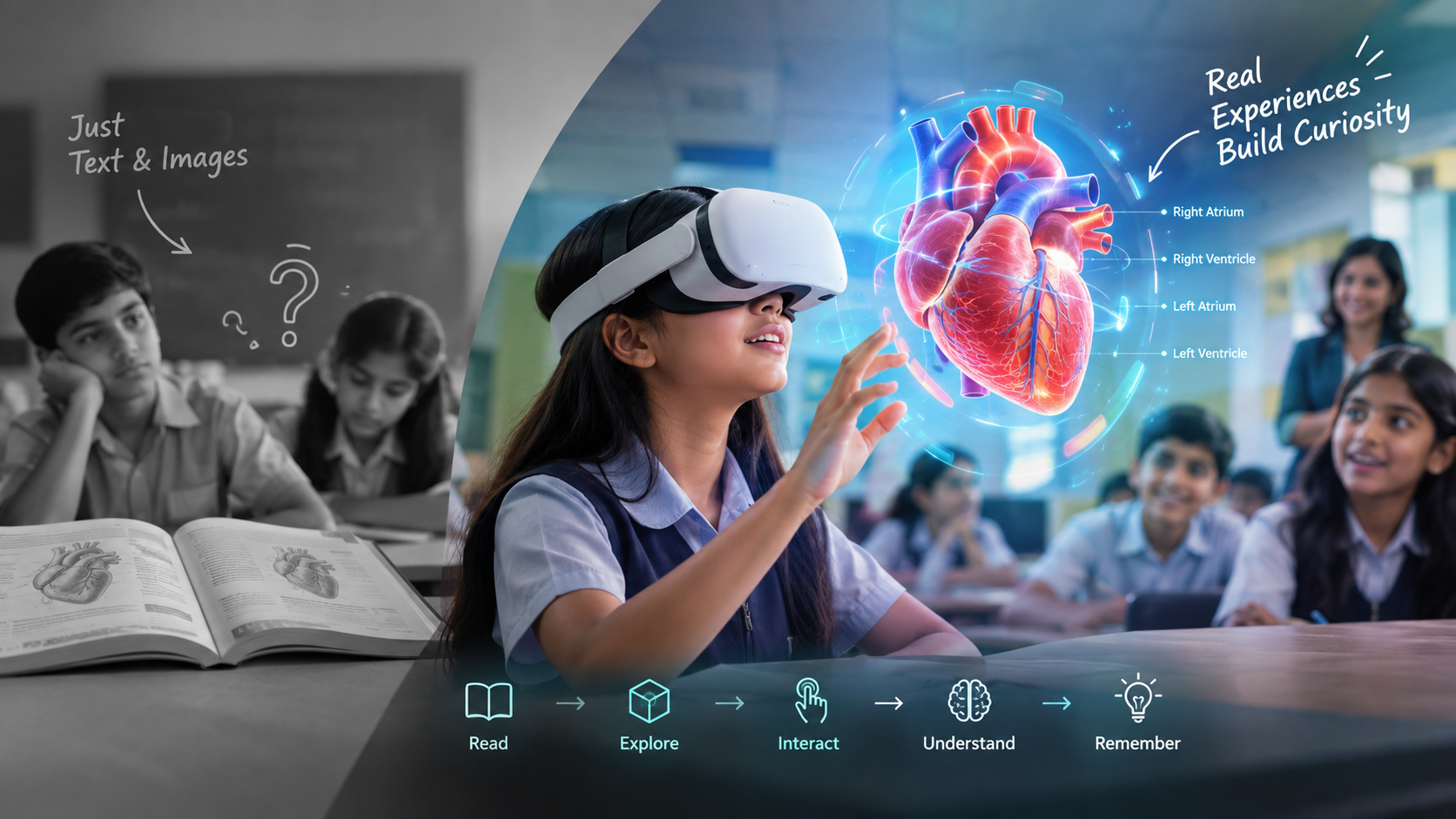
A student can read about the human heart, look at a diagram and memorize its parts. But reading about something and actually understanding how it works are two different experiences.
For many scientific concepts, students need more than information.
They need to see it, explore it and understand how the different parts connect.
Consider learning about the human heart.
A textbook can show its chambers and blood vessels. A teacher can explain blood circulation on a board.
But imagine being able to explore a 3D heart, look at it from different angles and understand how blood moves through it.
The concept becomes something the student can experience, rather than something they simply have to remember.
Experience Can Build Confidence
One reason students hesitate to answer questions is uncertainty.
They may be thinking:
"What if my answer is wrong?"
When students have only memorized information, this uncertainty can be stronger.
Experiential learning can change the way students interact with a concept.
When students explore a model themselves, they can observe relationships that may be difficult to understand from a static image.
They begin to build their own mental picture of the concept.
And when the teacher asks a question later, the student isn't trying to recall a sentence from a textbook.
They can think back to what they saw and explored.
That difference can make classroom participation more natural.
From Memorising to Exploring
This is where immersive technologies such as Virtual Reality can become useful in education.
A VR learning environment can allow students to explore concepts from different perspectives.
For example, instead of only reading about the kidney, students can explore a 3D model and understand its structure spatially.
Instead of looking at a static diagram of the solar system, they can explore the relative positions and relationships between celestial bodies.
Instead of memorising a scientific process, they can observe how its different components interact.
The goal isn't to replace textbooks or teachers.
The goal is to provide another layer of learning where students can experience concepts that are otherwise difficult to visualize.
Curiosity Changes the Classroom
There is another important effect.
Curiosity creates questions.
When students see something they have never experienced before, they naturally start asking:
"Why does this happen?"
"What happens if I look from this side?"
"Why does this part work like that?"
"What would happen if this changed?"
These questions can transform the classroom.
The teacher is no longer only delivering information.
The teacher becomes someone who guides students through their curiosity.
And that is where technology becomes useful — not because it is technology, but because it can create experiences that encourage students to explore.
The Role of VR Labs in Learning
A VR lab should therefore not be viewed simply as a room filled with headsets.
Its real value lies in how those experiences are connected to the curriculum.
A good learning cycle can look like:
Read → Explore → Interact → Understand → Remember
Students first learn the fundamentals from their teacher and learning material.
Then they can use immersive experiences to explore the concept, interact with it and build a stronger understanding.
The teacher can then bring the experience back into the classroom through questions, discussions and activities.
This makes VR a supporting tool within the learning process — not a replacement for the teacher.
The Goal Isn't More Technology. It's Better Learning.
The conversation around education technology often becomes focused on devices, AI, VR and new hardware.
But the more important question is:
Does the technology help a student understand something better?
If the answer is yes, it has a meaningful place in education.
For science especially, many concepts are naturally visual and spatial. Students should have opportunities to go beyond simply seeing a diagram of something and start exploring what that diagram represents.
This is the idea behind DesignXR — creating immersive learning experiences that help students explore complex concepts in a more visual and interactive way.
Because the ultimate goal isn't to make students use VR.
The goal is to make students understand, remember and become curious enough to ask the next question.
And perhaps that is the real transformation we want to see in a classroom:
Not a classroom where every student simply knows the answer,
but a classroom where every student is curious enough to ask why.