
K-12 VR Lab Setup in India: The Complete Guide to Cost, Curriculum, Safety & ROI
A school VR lab is no longer simply a room filled with expensive headsets.
When planned correctly, a Virtual Reality (VR) Lab for schools becomes a structured learning environment where students can explore science, engineering, anatomy, astronomy and other difficult concepts in three dimensions.
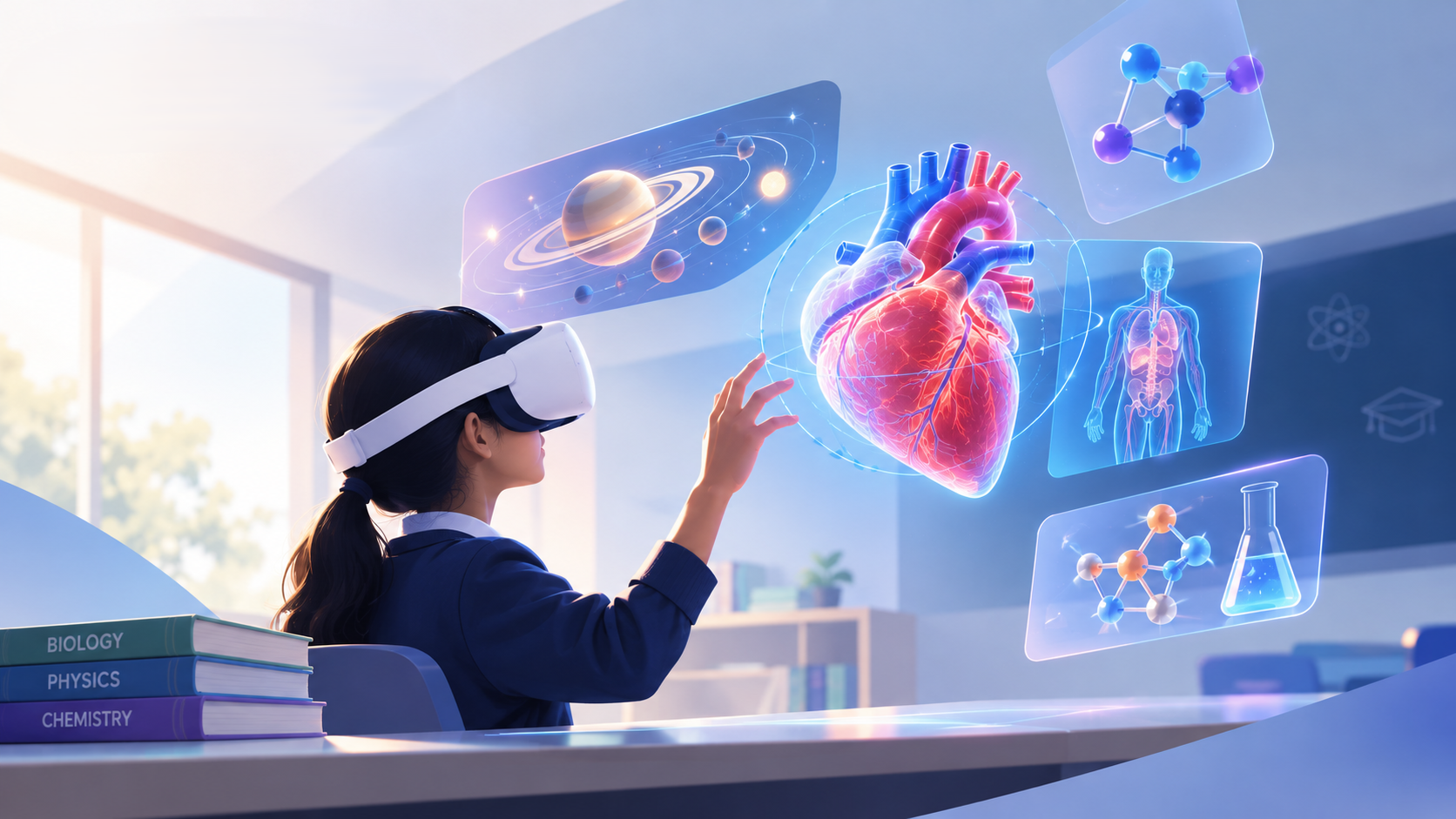
Instead of only looking at a diagram of the human heart, students can explore a life-sized 3D heart. Instead of memorising the layers of the Earth, they can examine them spatially. Instead of seeing a textbook illustration of a magnetic field, they can observe and interact with a virtual representation.
But before a school invests in VR, the important questions are practical:
How much does a VR lab cost?
How many headsets are required?
Does it support CBSE and NCERT?
How much space is needed?
Does it require high-speed internet?
Is VR safe for students?
What about student data and privacy?
How will teachers use it in a real classroom?
What is the return on investment?
This guide answers those questions and provides a practical framework for schools, school groups, principals, trustees, educators and education-technology decision-makers in India.
What Is a VR Lab for Schools?
A school VR lab is a dedicated or shared learning setup that combines VR headsets, educational software, curriculum-linked experiences, classroom procedures and teacher guidance.
The key difference between an educational VR lab and a gaming setup is the purpose.
A gaming room is designed primarily for entertainment.
An educational VR lab should be designed around:
Curriculum → Learning Objective → Experience → Teacher Guidance → Discussion → Assessment
The headset is only the hardware. The real value comes from what students do with it.
For example, a biology lesson on the circulatory system can move from a textbook explanation to an immersive 3D experience in which students examine the heart, chambers, valves and blood-flow pathway.
A physics lesson can similarly move from a static diagram to an interactive model of forces, electricity, magnetism, optics or mechanical systems.
That is why schools should evaluate a complete learning system, rather than buying headsets first and deciding what to teach later.
Why Should Schools Consider a VR Lab?
Smartboards, projectors, educational videos and digital content have already transformed classrooms. VR does not need to replace these technologies.
Instead, VR can fill a different gap: spatial and experiential learning.
1. Turn abstract concepts into 3D experiences
Many school concepts are difficult because they are invisible, microscopic, enormous, internal or spatial.
Consider:
Human organs
Cells and cellular processes
Atomic structures
Molecular bonding
Electromagnetic fields
Planetary systems
Earth's internal layers
Mechanical assemblies
Complex biological systems
A textbook can describe these concepts effectively, but VR can add a sense of scale, depth, position and interaction.
The objective is not to make every lesson “VR.”
The objective is to use VR where spatial or experiential representation adds genuine learning value.
2. Move from passive viewing to active exploration
A student watching a science video is primarily observing.
In an interactive VR lesson, students may be able to move around a model, inspect components, manipulate objects and follow a guided sequence.
This creates a different classroom behaviour:
Read → Explore → Interact → Understand → Remember
This is also the learning philosophy behind DesignXR's approach to immersive education. DesignXR describes its system as moving students from reading a concept to exploring and interacting with it in XR.
3. Make difficult science concepts easier to visualise
Imagine explaining:
“The left ventricle pumps oxygenated blood into the aorta.”
A student can read the sentence.
A teacher can draw it.
A video can demonstrate it.
A VR experience can allow the student to examine the heart in 3D and follow the pathway spatially.
The goal is not technology for its own sake. It is better representation of the concept.
Is a VR Lab Aligned with CBSE and NCERT?
This is one of the most important questions for a school.
The answer depends on the content provider and the quality of its curriculum mapping.
CBSE publishes curriculum and subject frameworks for its academic years, while NCERT publishes the textbooks and learning materials used extensively across Indian schools. The current CBSE 2026–27 curriculum includes Science among the main secondary subjects, and NCERT continues to publish its school science textbooks and associated learning materials.
A school should therefore not accept the statement “CBSE aligned” at face value.
Ask the vendor to demonstrate:
Class → Subject → Chapter/Topic → Learning Objective → VR Experience
For example:
| School requirement | What to verify |
|---|---|
| CBSE Science | Chapter and topic mapping |
| NCERT Science | Textbook/topic correlation |
| Learning outcomes | Specific outcome attached to each module |
| Teacher usage | Lesson guidance and classroom workflow |
| Assessment | Questions, discussion prompts or post-lesson activities |
| Board changes | Process for updating content |
DesignXR currently positions its XR library around school curriculum content and states that its experiences are aligned with CBSE, NCERT and state-board requirements. Its public product site describes curriculum coverage spanning Grades 5–12, with science experiences across biology, chemistry, physics and astronomy.
For procurement, however, schools should still request the actual curriculum mapping document before signing a large deployment.
What Subjects Can Be Taught in a School VR Lab?
A good school VR lab should support multiple use cases instead of becoming a single-purpose “VR demo room.”
Biology and Human Anatomy
VR can be particularly useful for visualising structures that are difficult to observe directly.
Potential experiences include:
Human heart
Circulatory system
Digestive system
Nervous system
Cells
Cell division
DNA and genetics
Ecosystems
Human organs
DesignXR's current curriculum pages highlight human anatomy, cells, organ systems and ecology among its biology experiences.
Physics
Physics concepts can benefit from 3D visualisation and interaction.
Examples include:
Force and motion
Newton's laws
Electricity
Circuits
Magnetism
Light and optics
Sound
Waves
Gravitation
Atomic structure
Chemistry
Virtual environments can provide a controlled way to represent structures, reactions and laboratory scenarios.
Examples include:
Atoms
Molecules
Chemical bonding
Periodic table
Acids and bases
Chemical reactions
Electrochemistry
Laboratory simulations
Astronomy and Space Science
Some subjects are naturally difficult to experience physically.
VR can allow students to:
Explore the solar system
Understand moon phases
Examine Earth's layers
Explore planetary surfaces
Visualise stars and their life cycles
Understand astronomical distances and scale
Engineering and Future Skills
A school can also extend VR beyond traditional science.
Possible areas include:
Machines
Engines
Structural design
Electronic circuits
Robotics
Renewable energy
Design thinking
Artificial intelligence concepts
Computational thinking
VR/AR creation
The important principle is simple:
The technology should follow the curriculum, not the other way around.
How Much Does a School VR Lab Cost in India?
There is no single “VR lab price” because the total investment depends on several variables.
The biggest cost factors are:
Number of headsets
A five-headset pilot is completely different from a 20-, 30- or 50-headset school deployment.
Headset model
Standalone educational VR headsets can reduce the infrastructure complexity associated with PC-based VR systems.
Educational software
The software model may be perpetual licensing, annual subscription, per-device licensing, school-wide licensing or an enterprise deployment agreement.
Content scope
A science-only library is different from a multidisciplinary K-12 curriculum.
Installation and training
A professional deployment may include configuration, teacher orientation, classroom workflow training and technical support.
Networking and charging
Schools need appropriate charging, storage, device management and local connectivity.
Room preparation
Some deployments require little more than an existing classroom, while larger installations may require additional electrical, storage or furniture work.
A practical VR lab budgeting model
Instead of asking:
“How much does one VR headset cost?”
School management should calculate:
Total VR Lab Cost = Hardware + Software + Infrastructure + Installation + Training + Support
This produces a much more realistic procurement figure.
For example, a school may begin with a small pilot to validate classroom usage before expanding to a larger device fleet.
That approach reduces risk and allows the school to measure student engagement, teacher adoption and actual utilisation before making a larger capital investment.
How Many VR Headsets Does a School Need?
You do not necessarily need one headset for every student.
That is one of the biggest misconceptions around school VR labs.
A school can use a rotation model.
For example:
A class of 40 students could be divided into groups.
One group uses VR.
Another group works on a teacher-guided worksheet.
Another group participates in a classroom discussion or related activity.
Students rotate between activities.
This allows schools to use fewer headsets while still integrating VR into an entire class.
A smaller pilot can therefore be useful when a school is testing the technology for the first time.
The correct number of devices depends on:
Student strength
Class size
Timetable
Session duration
Number of simultaneous users
Curriculum frequency
Available space
Budget
A vendor should recommend the device count based on the school's timetable, not simply sell the maximum possible number of devices.
How Much Space Is Required for a VR Lab?
A school does not necessarily need to construct a huge technology centre.
Standalone VR systems reduce the need for the traditional PC-based VR arrangement of powerful desktop computers, cables and external tracking hardware.
But “small room” does not mean “ignore safety.”
The space should be planned around:
Clear play areas
Students should have enough unobstructed space for the interaction method being used.
Physical separation
Multiple students using VR simultaneously need sufficient spacing to reduce the risk of collisions.
Teacher visibility
The teacher should be able to observe students rather than leave the class unsupervised.
Storage
Headsets should have a secure, organised storage and charging process.
Cleaning
The school should establish a routine for cleaning shared facial-contact surfaces.
Emergency access
The room should remain easy to enter and exit.
A good VR lab is therefore less about constructing an enormous room and more about designing a safe, repeatable classroom workflow.
What Equipment Is Required for a School VR Lab?
A typical standalone VR lab may include:
VR Headsets
The core immersive hardware.
DesignXR currently presents Meta Quest hardware as its primary VR lab platform on its public site.
Educational VR Software
The software should contain structured, curriculum-relevant experiences rather than a collection of entertainment apps.
Charging and Storage
Schools need a reliable process for charging, storing and issuing headsets.
Networking
Depending on the application, networking may be required for setup, updates, authentication or multiplayer functionality.
Teacher Device
A teacher may need a laptop, tablet or compatible device to manage the lesson or classroom workflow depending on the platform.
Hygiene Supplies
Shared VR devices require routine cleaning, particularly surfaces that contact the student's face.
Optional AR Devices
A school can also combine VR with tablet/mobile AR to create a broader AR + VR learning lab.
This is one approach supported by DesignXR, which describes a combined AR/VR setup using tablets for AR learning and headsets for immersive experiences.
Does a School VR Lab Need High-Speed Internet?
Not always.
This depends entirely on the architecture of the VR platform.
Some solutions depend heavily on cloud services, streaming, online authentication or real-time data synchronisation.
Other systems are designed primarily around local or offline experiences.
For Indian schools, this is an important procurement question because internet reliability varies significantly between locations.
Before purchasing, ask:
Can the core educational content run offline?
Does every headset need continuous internet access?
Are updates downloaded separately?
Is a school server required?
Is cloud storage required?
Does multiplayer require internet or can it run on a local network?
A school should choose the architecture that fits its actual infrastructure rather than assuming that every VR solution works the same way.
VR Safety in Schools: What Principals Should Know
Safety should be treated as part of the implementation plan, not as an afterthought.
Modern VR platforms include physical-space safety mechanisms. Meta, for example, describes boundary features that alert users as they approach the edge of their defined play area.
For a school deployment, safety should include several layers.
1. Follow the headset's age and safety requirements
Age suitability is not something a school should invent independently.
Meta currently supports parent-managed Quest accounts for children aged 10–12, alongside additional youth protections and age-specific developer requirements.
Schools should therefore verify:
Device age requirements
Application age classification
Account requirements
Manufacturer safety instructions
Local school policy
2. Teacher supervision
Students should not be left alone while using immersive equipment.
Teachers or trained facilitators should supervise the session and know how to safely stop the experience.
3. Short, structured activities
There should not be a blanket promise that one fixed session length is “safe for everyone.”
Students respond differently to immersive experiences.
A school should use structured sessions, monitor student comfort and immediately stop participation when a student reports discomfort, dizziness, nausea, eye strain or other symptoms.
4. Physical environment
Before every session:
Clear obstacles.
Check the floor.
Maintain spacing between students.
Define the play boundary.
Keep teachers visible and accessible.
5. Hygiene
Shared headsets should have a documented cleaning process.
This should become part of the lab's daily operating procedure.
Student Data Privacy: What Should Schools Ask?
Student privacy is increasingly important for every digital learning platform.
India's Digital Personal Data Protection framework is now a significant consideration for organisations processing personal data, and the Government of India notified the Digital Personal Data Protection Rules, 2025 in November 2025. The government also established a phased implementation timeline for the framework.
Schools should therefore ask every EdTech and XR provider:
What student data is collected?
Is a student account required?
Are names, email addresses or phone numbers stored?
Is voice or video recorded?
Is usage analytics collected?
Where is data stored?
How long is data retained?
Who can access it?
Can the school delete the data?
Does the platform require third-party analytics or advertising SDKs?
The ideal principle for classroom technology is:
Collect only the data genuinely required to deliver the learning experience.
A VR application that can deliver curriculum content without unnecessarily creating student profiles can simplify privacy management.
VR Lab vs Smartboard vs Video: Which Is Better?
The correct answer is none of them should automatically replace the others.
Each technology has a different role.
| Technology | Best suited for |
|---|---|
| Textbook | Reading, reference and structured curriculum |
| Smartboard | Whole-class visual teaching |
| Video | Demonstration, storytelling and explanation |
| 3D models | Spatial understanding |
| AR | Bringing digital information into the physical environment |
| VR | Immersive exploration and spatial experiences |
The strongest modern classroom may use all of them.
The question should not be:
“Should we replace our smartboard with VR?”
It should be:
“Which concepts benefit enough from immersion to justify using VR?”
That is a much better technology strategy.
How Should Teachers Use VR in a Real Classroom?
Buying VR hardware without a teaching methodology can lead to very low utilisation.
A successful school deployment should have a defined lesson flow.
Before the VR session
The teacher introduces the concept.
Students understand what they are about to explore.
During the VR session
Students enter the experience and investigate the relevant model or environment.
The teacher guides the activity.
After the VR session
Students remove the headsets and discuss what they observed.
The teacher connects the experience back to the textbook and learning objective.
Students complete questions, diagrams, activities or assessments.
This creates a simple learning loop:
Prepare → Experience → Discuss → Apply
That is far more educationally valuable than allowing students to simply “try VR.”
How Does VR Fit with NEP 2020?
India's National Education Policy 2020 places strong emphasis on experiential learning, hands-on learning, inquiry, discovery, discussion and deeper understanding of concepts. It explicitly describes experiential learning as a standard pedagogical approach across stages of education.
That does not mean NEP 2020 mandates VR.
It means that VR can be one technological tool used to support an experiential learning approach.
This distinction is important.
Schools should not purchase VR merely because it is associated with “future-ready education.”
The stronger justification is:
Use immersive technology where it meaningfully supports the learning objective.
Can VR Replace the Physical Science Lab?
No.
A physical laboratory and a VR laboratory serve different purposes.
A physical laboratory develops real-world practical skills involving physical materials, instruments, measurement and procedures.
VR can complement it by allowing students to visualise processes that are:
Dangerous
Expensive
Too small
Too large
Difficult to reproduce
Difficult to observe directly
Impossible to perform frequently
The best model is often:
Physical Lab + Digital Simulation + VR Exploration
rather than choosing only one.
What Is the ROI of a School VR Lab?
This is where school management needs to think beyond the initial equipment price.
ROI can be measured in at least four dimensions.
1. Learning ROI
Ask:
Are students understanding difficult concepts more easily?
Are teachers able to explain spatial concepts more effectively?
Are students participating more actively?
Are the experiences actually being used in lessons?
2. Operational ROI
Ask:
How many classes can use the lab?
How many students can be served per week?
How many subjects use the platform?
How frequently are the headsets being utilised?
A ₹10 lakh lab that is used twice a month has very different economics from a smaller lab used every day.
3. Institutional ROI
Schools may also view immersive technology as part of their STEM, innovation and technology positioning.
A modern experiential learning facility can support school demonstrations, parent engagement, STEM events and institutional differentiation.
DesignXR reports that more than 200 learners, educators and parents have experienced its demonstrations and showcases, and its website documents a Goa VR Science Lab implementation for Classes 6–10 inaugurated on 24 July 2026.
4. Admissions and brand ROI
A technology lab can become part of a school's broader proposition around:
STEM Education
Experiential Learning
Innovation
Future Skills
Technology-enabled Classrooms
However, schools should not assume that a VR lab automatically produces more admissions.
Admissions impact should be measured through the school's actual marketing, parent engagement and enrolment data.
A Better Way to Calculate VR Lab ROI
Instead of using a vague statement like “VR increases admissions,” create measurable metrics.
For example:
Annual Students Served
= Students using VR per session × Number of sessions × Annual utilisation
Cost Per Student Experience
= Total annual VR programme cost ÷ Number of student experiences
Device Utilisation
= Actual usage hours ÷ Available lab hours
Teacher Adoption
= Number of teachers actively using the system ÷ Number of trained teachers
Learning Impact
= Pre-lesson assessment vs post-lesson assessment
The exact formulas can be customised for each school.
This turns VR from a technology purchase into a measurable education programme.
Should a School Start with 5–10 Headsets or Build a Large VR Lab?
For many schools, a pilot-first strategy is sensible.
Start with a manageable number of devices.
Run real lessons.
Train teachers.
Measure utilisation.
Collect student and teacher feedback.
Then decide whether to scale.
A pilot also allows schools to discover issues that are difficult to predict before deployment:
Timetable conflicts
Charging procedures
Teacher adoption
Student rotation
Room layout
Hygiene workflow
Device management
Content gaps
Network limitations
A good vendor should be comfortable with a school starting small and scaling after proving classroom value.
What Should a School Ask a VR Vendor Before Buying?
Before issuing a purchase order, ask for a clear answer to these questions.
Curriculum
Which classes are covered?
Which subjects are covered?
Can you provide chapter-level CBSE/NCERT mapping?
How are syllabus updates handled?
Hardware
Which headset do you recommend and why?
How long does the hardware normally last under school usage?
What happens if a headset fails?
Is there a warranty and replacement process?
Software
Is licensing per device, per school or subscription-based?
What happens when the licence expires?
Are updates included?
What content is currently available?
Infrastructure
How much room is required?
Does the system require internet?
Does it require PCs or servers?
What charging and storage setup is required?
Safety
What age groups are supported?
What safety procedures are recommended?
How are students supervised?
Privacy
What data is collected?
Where is it stored?
Is student tracking enabled?
Can the school operate without creating individual student accounts?
Training
Who trains the teachers?
Is training included?
Is there ongoing technical support?
A serious education technology provider should be able to answer these questions clearly.
Why DesignXR?
DesignXR is an immersive learning platform focused on VR, AR and AI-enabled learning systems for schools.
Its public platform currently presents curriculum experiences across areas including:
Biology
Chemistry
Physics
Astronomy
Engineering
Future Skills
DesignXR describes its VR experiences as curriculum-aligned and currently showcases Meta Quest-based immersive learning, multilingual experiences and school-focused VR lab deployments.
The platform's learning approach is built around:
Read → Explore → Interact → Understand → Remember
Rather than treating VR as entertainment, the objective is to turn difficult concepts into interactive learning experiences.
DesignXR also positions its solution for schools that want to start with immersive learning and scale over time, including standalone VR and combined AR + VR deployments.
A Practical School VR Lab Implementation Plan
A school can use the following five-stage roadmap.
Stage 1 — Identify learning problems
Select concepts where students struggle with:
Visualisation
Spatial understanding
Scale
Complex systems
Unsafe or impractical experiments
Stage 2 — Run a live demonstration
Do not decide based only on a brochure.
Allow teachers and students to experience actual lessons.
Stage 3 — Start with a pilot
Deploy a manageable number of devices and test the workflow.
Stage 4 — Train teachers
Teachers should understand not only how to operate the headset, but also how to connect the experience to the curriculum.
Stage 5 — Measure and scale
Track:
Usage
Teacher adoption
Student participation
Learning outcomes
Technical issues
Cost per student
Then expand the programme based on evidence.
The Future of School VR Is Not “More Technology”
The future of educational VR is not about putting a headset on every child for every lesson.
It is about using immersion at the right moment for the right concept.
A student does not need VR to learn every definition.
A teacher does not need VR to explain every chapter.
But when a concept is microscopic, enormous, internal, invisible, spatial or difficult to reproduce physically, immersive learning can become an extremely powerful teaching medium.
The strongest school VR strategy is therefore:
Textbook for foundation.
Teacher for explanation.
VR for exploration.
Discussion for understanding.
Assessment for evidence.
That is how a VR lab becomes part of education rather than simply becoming another piece of school technology.
Frequently Asked Questions About School VR Labs
What is a VR lab in a school?
A school VR lab is a learning setup that combines immersive VR headsets with educational software, curriculum-linked content, classroom procedures and teacher guidance.
How much does a VR lab cost in India?
There is no universal price. The final cost depends on headset count, VR software licensing, curriculum scope, installation, teacher training, charging/storage and support.
How many VR headsets does a school need?
It depends on class size, timetable and utilisation. Schools can use rotation-based models instead of buying one headset per student.
Is VR suitable for CBSE schools?
Yes, VR can be used alongside CBSE teaching when the educational content is mapped appropriately to the relevant curriculum and learning objectives. Schools should ask the vendor for chapter-level curriculum mapping.
Is VR part of NEP 2020?
NEP 2020 promotes experiential learning and technology-enabled education, but it does not mean that every school must use VR. VR is one possible tool for supporting experiential learning.
Does a VR lab need a large room?
Not necessarily. Standalone headsets can reduce infrastructure requirements, but the room must still provide safe movement, adequate spacing, teacher visibility and secure storage.
Does a school VR lab require internet?
It depends on the software architecture. Some systems rely heavily on cloud services while others can support offline/local use. Schools should confirm this before purchasing.
Is VR safe for school students?
VR should be deployed according to the headset manufacturer's age, health and safety requirements, with teacher supervision, appropriate play-space boundaries and a process for stopping sessions when students experience discomfort. Meta currently provides specific protections and account arrangements for younger Quest users, including ages 10–12.
Can VR replace a physical science lab?
No. VR is best viewed as complementary to physical laboratory learning.
Can VR improve school admissions?
A VR lab can contribute to a school's technology and experiential-learning proposition, but admissions impact varies by institution and should be measured rather than assumed.
Can a school start with a small VR pilot?
Yes. A pilot can help the school test content quality, teacher adoption, timetable integration, safety procedures and actual utilisation before scaling.
Conclusion: Build a Learning Lab, Not a Headset Room
A successful K-12 VR lab is not defined by how many headsets a school owns.
It is defined by how effectively those devices are connected to:
Curriculum
Teachers
Learning outcomes
Student experience
Safety
Privacy
Measurable utilisation
The right question is not:
“Should our school buy VR?”
The better question is:
“Where can immersive learning solve a real teaching problem better than the tools we already use?”
For schools that identify strong use cases, a well-designed VR lab can become a practical extension of modern STEM and experiential learning — without turning the classroom into a gaming centre.
Bring Experiential VR Learning to Your School
DesignXR helps schools explore immersive learning through curriculum-aligned VR and AR experiences across science and related subjects.
Book a school VR demo and experience the platform with your teachers and students.
DesignXR
Pune, Maharashtra, India
Email: tarun@itsikhwal.com
WhatsApp / Phone: +91 77098 46067
Website: dxr.itsikhwal.com
Book a School Demo: Contact the DesignXR team for a personalised walkthrough and VR lab proposal.
Important: Curriculum coverage, supported devices, pricing, licensing, age suitability and infrastructure requirements can change by deployment. Schools should request the latest technical and curriculum documentation before procurement.