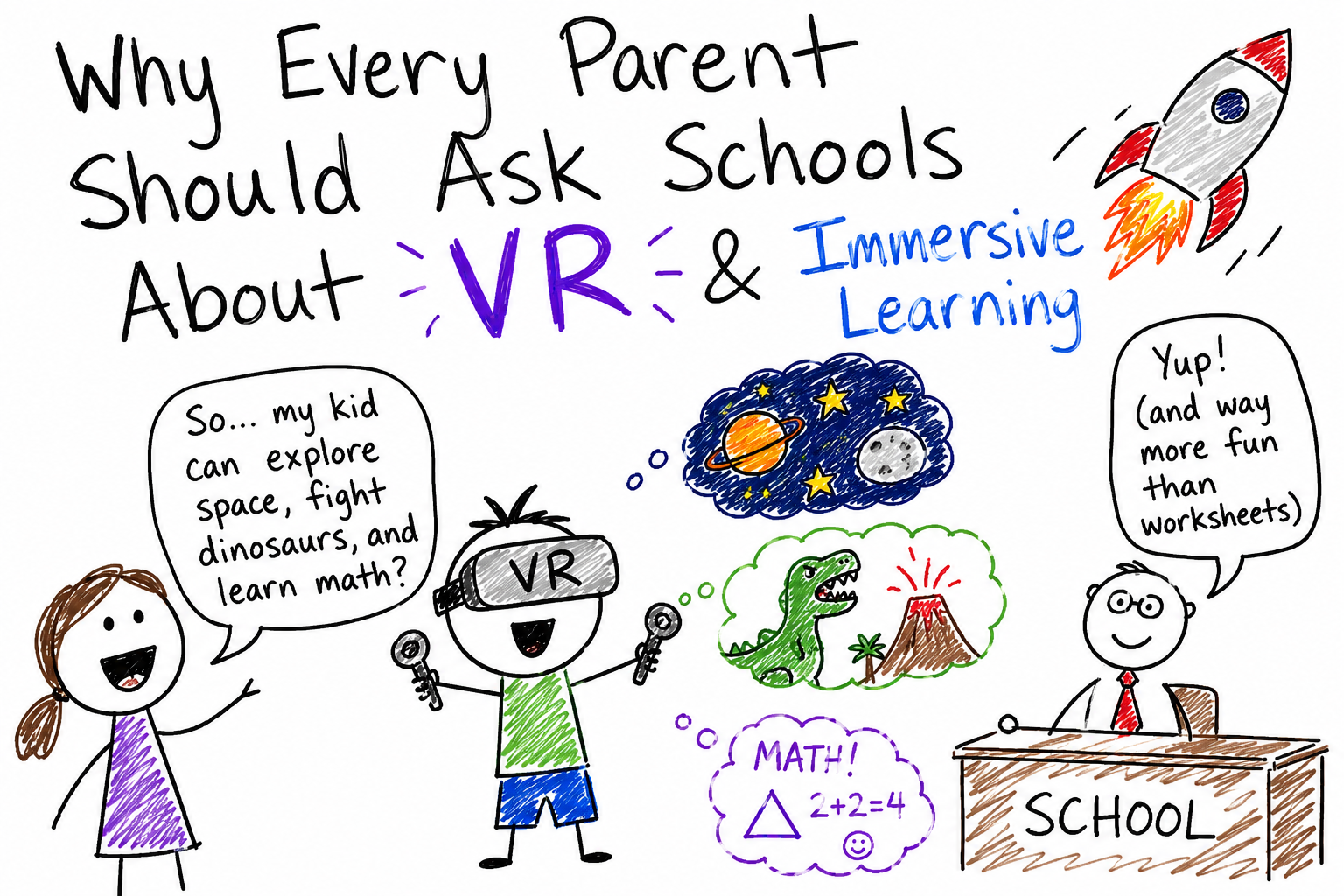
Many parents today are asking an important question: “Is traditional classroom learning enough for the future?”
The reality is that students today grow up surrounded by technology, interactive media, and visual experiences. Yet many classrooms still rely heavily on textbooks and one-way lectures.
This creates a huge gap between how students naturally learn and how they are being taught.
The schools and colleges that adopt immersive learning early will become the future leaders in education.
Why Students Struggle With Complex Subjects
Many students struggle not because they are weak — but because concepts are difficult to visualize.
Subjects like Physics, Chemistry, Biology, Mathematics, Astronomy, and Engineering often require imagination and spatial understanding.
Reading about planets, molecules, electric fields, engines, or anatomy in books is very different from experiencing them interactively.
Traditional Learning Problems
- Students memorize instead of understanding
- Complex concepts become boring
- Limited practical visualization
- Low engagement in classrooms
- Fear of science and mathematics
- Lack of interactive experiences
How Immersive VR Learning Changes Everything
Imagine a student learning about the solar system by actually standing inside it.
Imagine grabbing a planet in hand, rotating it, exploring its atmosphere, size, gravity, and distance from the sun in real-time.
Instead of memorizing chemistry reactions from textbooks, students can interact with molecules and understand atomic structures visually.
Instead of reading biology diagrams, students can walk through the human heart, brain, lungs, or nervous system in immersive 3D.
Immersive learning transforms “studying” into “experiencing.”
Introducing DesignXR for Education
DesignXR is focused on transforming education through immersive and interactive XR learning experiences powered by VR, AR, AI, and real-time 3D technologies.
Our goal is simple: Make learning easier, engaging, practical, and unforgettable.
What DesignXR Enables Students To Do
🌍 Explore Space in VR
Students can hold planets, explore solar systems, understand gravity, orbital motion, and astronomy concepts interactively.
🧪 Interactive Chemistry
Visualize atoms, molecules, reactions, and chemical structures through immersive simulations instead of static diagrams.
🫀 Biology in 3D
Walk through organs, anatomy systems, cells, and human body structures using immersive VR learning experiences.
⚙️ Engineering Simulations
Understand machines, engines, mechanisms, robotics, circuits, and industrial systems interactively.
Designed for Students From Grade 6 to Engineering
DesignXR learning solutions are built for:
- Middle School Students (Grade 6–8)
- Secondary School Students (Grade 9–10)
- Higher Secondary Students (11–12 Science)
- Engineering Colleges
- STEM Labs
- Skill Development Institutes
Benefits of VR Learning for Schools & Colleges
Higher Student Engagement
Students naturally stay more focused during immersive learning sessions.
Improved Academic Performance
Better understanding leads to better retention and stronger exam performance.
Reduced Fear of Difficult Subjects
Interactive visualization makes science and mathematics easier and more enjoyable.
Modern School Branding
Schools using immersive technology stand out as innovative and future-ready institutions.
Increased Admissions
Parents are increasingly looking for schools that provide advanced technology-driven learning experiences.
Parents should encourage schools and colleges to adopt immersive education technologies because they directly improve learning quality and student confidence.
Why Parents Should Share This With Schools
Education should evolve with the world students are preparing for.
Tomorrow’s careers will require:
- Creative problem-solving
- Spatial understanding
- Interactive learning
- Technology fluency
- Practical skills
- Innovation mindset
Immersive learning helps students build these skills naturally.
Parents can play a major role by encouraging schools and colleges to explore VR, AR, AI, and XR learning solutions.
The Future of Education Is Immersive
The future classroom will not only use books and boards.
It will combine:
- AI-powered learning
- Immersive VR experiences
- AR-enhanced classrooms
- Interactive simulations
- Real-time 3D visualization
- Hands-on digital exploration
Students remember experiences far more than lectures.
Final Thoughts
The world is changing rapidly, and education must evolve alongside it.
Immersive learning is no longer a futuristic concept — it is becoming the new standard for effective education.
Schools and colleges that adopt technologies like VR, AR, AI, and XR today will create more engaged students, better learning outcomes, and future-ready classrooms.
And parents have the power to encourage this transformation.