
Dear Parent — If your child has ever come home from school and said "I don't understand" or "Science is boring"… this article is for you. Please read it, and then share it with their school.
Think back to how you learned the Solar System. A diagram on a page. Maybe a polystyrene model hanging from a ceiling. The teacher's voice describing the distance between Earth and Jupiter — a number so large it meant nothing to a 12-year-old.
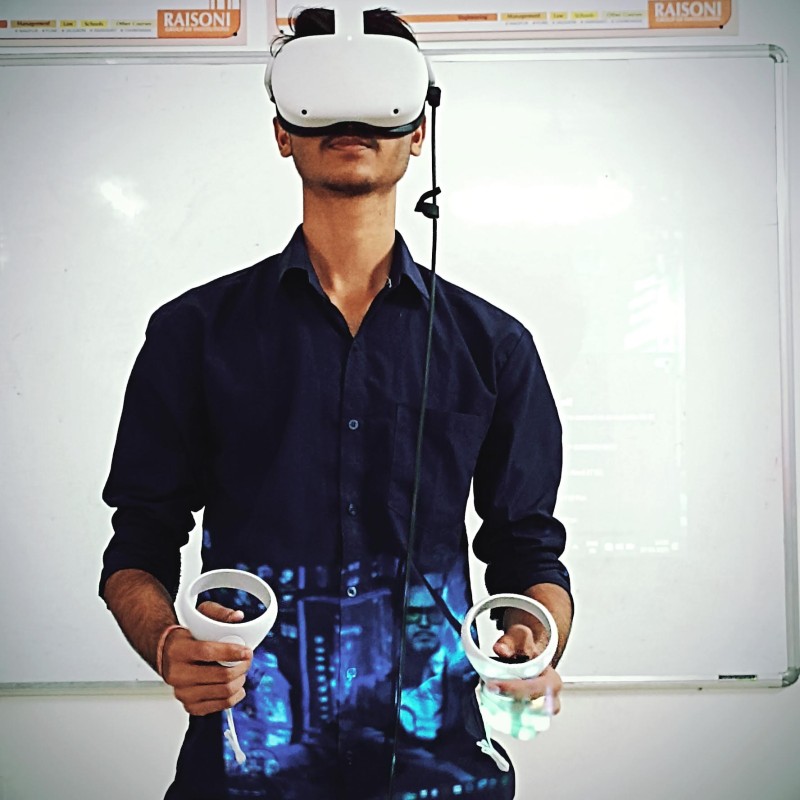
Now imagine your child reaching out their hand and picking up Saturn. Feeling its rings. Rotating it. Zooming in to see its moons orbiting in real time. Hearing contextual information delivered the moment they interact with each object. And then doing the same with a DNA double helix, a beating human heart, or a Newton's cradle operating in a zero-gravity environment.
That is not the future. That is DesignXR, available in India today.
Why the Way We Currently Teach Science Is Failing Our Children
Let us be honest. The traditional classroom — textbook, blackboard, memorisation — was designed for a world before computers, smartphones, and the internet. It made sense when a diagram in a printed book was the most visual thing a teacher could offer. That world no longer exists.
Today's children are growing up in a world of immersive video games, interactive apps, and on-demand video. Their brains are wired to engage with moving, interactive, responsive content. And then they sit in a classroom and are asked to visualise the structure of an atom from a static 2D drawing.
Studies in educational neuroscience consistently show that the human brain retains approximately 5% of information heard in a lecture, 10% of what is read — but up to 75–90% of what is experienced through active, hands-on practice. Yet the vast majority of Indian classrooms still rely on the first two methods.
The result? Children who memorise for exams and forget within weeks. Children who pass Chemistry tests but cannot picture a molecule. Students who can write the formula for photosynthesis but have never seen what it looks like inside a chloroplast.
The knowledge is there. The curiosity is there. What is missing is the right medium to make it real.
How Children Actually Learn — The Science of Memory
The human brain stores information in multiple memory systems. When only one sense is engaged — say, reading — only one pathway is activated. But when multiple senses work together — sight, spatial awareness, touch feedback, sound — the brain creates richer, more interconnected memories that are far more durable.
This is why you remember the smell of rain, the texture of a favourite blanket, or the feeling of your first bicycle ride decades later — but struggle to recall what you read in a book last week.
Virtual Reality (VR) is the first technology in human history that can engage spatial memory, visual memory, motor memory (through hand controllers), and auditory memory simultaneously — all while the student remains in active control of their experience. It is not a replacement for teaching. It is the most powerful amplifier of teaching ever created.
Not Just Learning About the World.
Living Inside It.
DesignXR is iTSikhwal's immersive education platform built specifically for Indian students from Class 6 to Class 12 and Engineering. It transforms every abstract concept in the syllabus into a 3D, interactive, hands-on experience that students control with their own hands.
What Your Child Actually Experiences in DesignXR
Here is a subject-by-subject look at what students see, feel, and interact with — and why it makes concepts that once seemed impossible to understand suddenly, obviously clear.
Forces, Motion & the Universe — Made Touchable
In DesignXR's Physics world, a student literally picks up planets with their hands and places them in orbit — feeling the gravitational relationships as they do. They can throw a ball in standard gravity, then switch to the Moon or Mars and watch how the trajectory changes in real time. Electromagnetic field lines become visible, glowing arcs that students can walk through. Lens refraction becomes a beam of light they bend themselves using hand controllers.
Molecules You Can Hold. Reactions You Can Watch.
Chemistry's greatest challenge is that it is invisible to the naked eye. In DesignXR, students hold a water molecule in their hand and see exactly how two hydrogen atoms bond with one oxygen. They can split a molecule apart and reassemble it. Titration experiments happen in a virtual lab they can conduct as many times as needed, without chemicals, without waste, and without risk. The Periodic Table becomes a room-scale interactive display where touching any element reveals its electron configuration, properties, and real-world uses.
Shrink to the Size of a Cell. Walk Through a Heart.
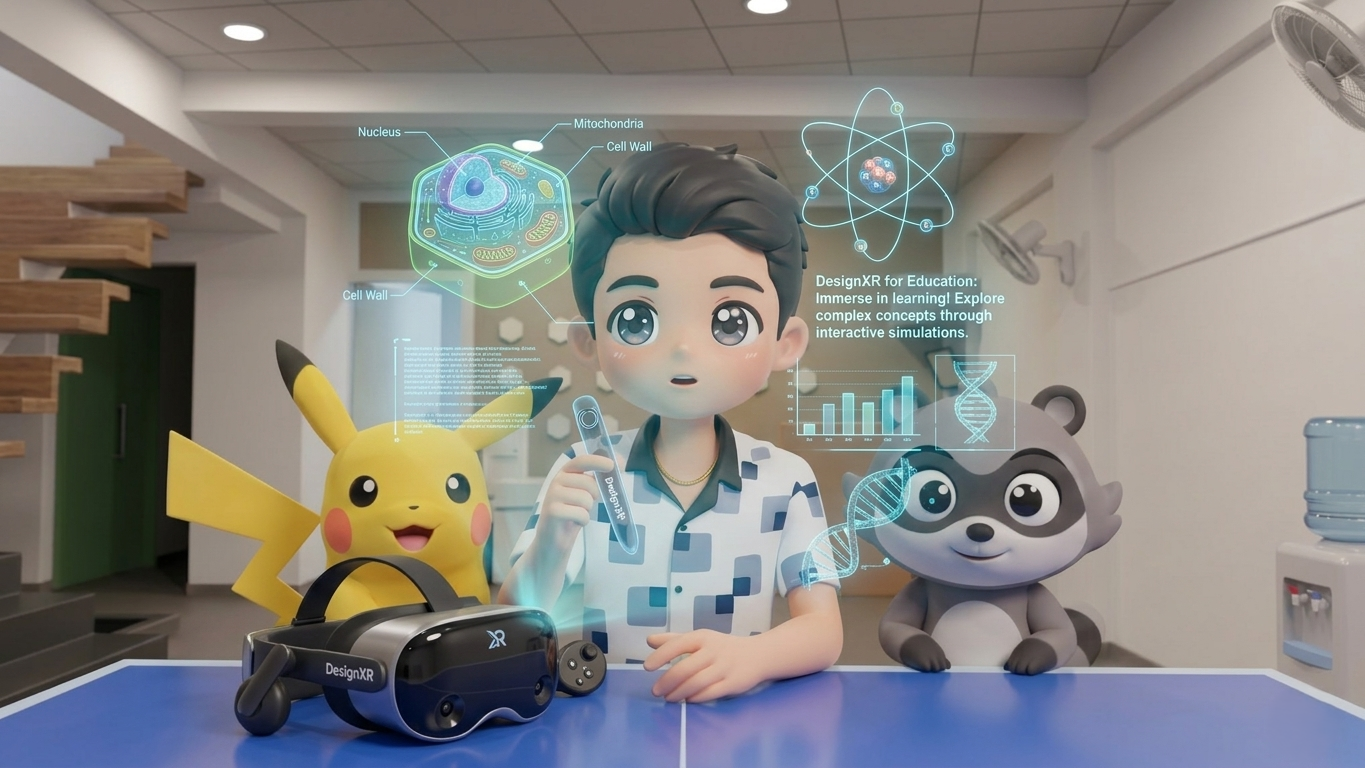
In DesignXR's Biology module, students are shrunk to microscopic scale and enter a living human cell. They can see mitochondria producing ATP, watch the nucleus directing protein synthesis, and observe cell division happening in slow motion around them. They walk through a virtual human heart, watching the chambers contract and blood cells flow through arteries. Photosynthesis becomes a light show inside a chloroplast. No animals are harmed — virtual dissection gives every student the full experience of understanding anatomy.
Assemble Engines. Build Circuits. Stress-Test Structures.
Engineering students can assemble an internal combustion engine part by part with their hands, watching how pistons, crankshafts, and valves interact. Electrical circuit design becomes a hands-on building exercise — place components, connect wires, and watch current flow in real time as animated electrons. Structural engineering students apply loads to virtual bridges and observe stress distribution, making material science viscerally understandable. Thermodynamics becomes visible heat maps and particle animations rather than abstract equations.
Geometry You Can Walk Through
3D geometry becomes room-scale. Students step inside polyhedra, unfold shapes with their hands, and watch calculus curves grow in real time. Probability distributions become physical landscapes. Trigonometry makes sense when you can stand inside a triangle.
Watch Tectonic Plates Move
Students stand on a virtual Earth and watch tectonic plates collide. They fly through a hurricane's eye wall. They observe ocean current patterns as glowing animated rivers. Volcanic eruptions, glacier formation, and climate systems become experiences — not paragraphs.
DesignXR Across Every Grade — Class 6 to Engineering
DesignXR is not a single experience. It is a growing library of immersive modules mapped precisely to the Indian curriculum at every level.
Solar System exploration (grab and place planets), basic cell structure, weather systems, fundamental forces, plant life cycles. Focus: wonder and engagement. Students who fall in love with science in Std 6 stay in love.
Atomic structure in 3D, molecular bonding, human body systems (digestive, circulatory), Newton's Laws in action, chemical reactions simulated. Students who struggled with abstract concepts find sudden clarity when they can see and touch the invisible.
Electricity & circuits (build and test live), light refraction and lenses, carbon compounds, reproduction in organisms, resource management simulations. Board exam topics become impossible to forget when experienced in 3D.
Organic chemistry reaction mechanisms animated step by step, electromagnetism field simulations, thermodynamic cycles visualised, genetics and DNA replication, quantum model of the atom. The concepts that break most JEE and NEET aspirants become intuitive through spatial experience.
Full engine assembly and disassembly, circuit simulation with live feedback, structural analysis with stress visualisation, fluid dynamics animations, PCB design in 3D space, and programming concept visualisation. Engineering concepts that students pay years of tuition to understand become clear in hours.
A Practical Guide for Parents: What to Do Next
You have read this far because you care deeply about your child's education. That is the most important ingredient. Now here is exactly what you can do:
Use the share buttons below. A single conversation between a parent and a school can spark a transformation for hundreds of children. You do not need to be a tech expert — just forward this page.
iTSikhwal offers free in-school demonstration sessions in Pune and surrounding areas. The team comes to the school with equipment. Students try DesignXR firsthand. The experience speaks for itself — no sales pitch needed.
Schools respond to parent interest. If three or four parents raise the same question — "Why isn't our school using VR for Science?" — the school listens. You have more power than you think.
You can reach the team at +91 77098 46067 or tarun@itsikhwal.com. They are based right here in Wagholi, Pune — local, accessible, and genuinely passionate about Indian education.
iTSikhwal provides end-to-end implementation — curriculum mapping, hardware consultation, teacher training, student dashboards, and ongoing support. This is not a product handoff. It is a partnership. Contact us for a customised proposal for your institution.
Why iTSikhwal & DesignXR — Not Any Other Platform
| What you need | Generic platforms | DesignXR by iTSikhwal ✓ |
|---|---|---|
| Indian curriculum alignment | ❌ Foreign syllabus | ✅ CBSE / ICSE / SSC / BE |
| Hindi & Marathi support | ❌ English only | ✅ Multi-language |
| Local on-site support | ❌ Remote / email only | ✅ Wagholi, Pune — nearby |
| Teacher training | ❌ Self-serve only | ✅ Full training program |
| Budget-friendly for India | ❌ USD pricing | ✅ INR, flexible models |
| Content for Std 6–12 + Engg | ❌ Partial / single subject | ✅ Full cross-curricular |
| Parent & student dashboards | ❌ Basic or absent | ✅ Real-time analytics |
Your Child Deserves to Experience
Learning — Not Just Sit Through It.
Share this article with their school today. One conversation can change everything.
📍 iTSikhwal · Wagholi, Pune 412207 · +91 77098 46067