
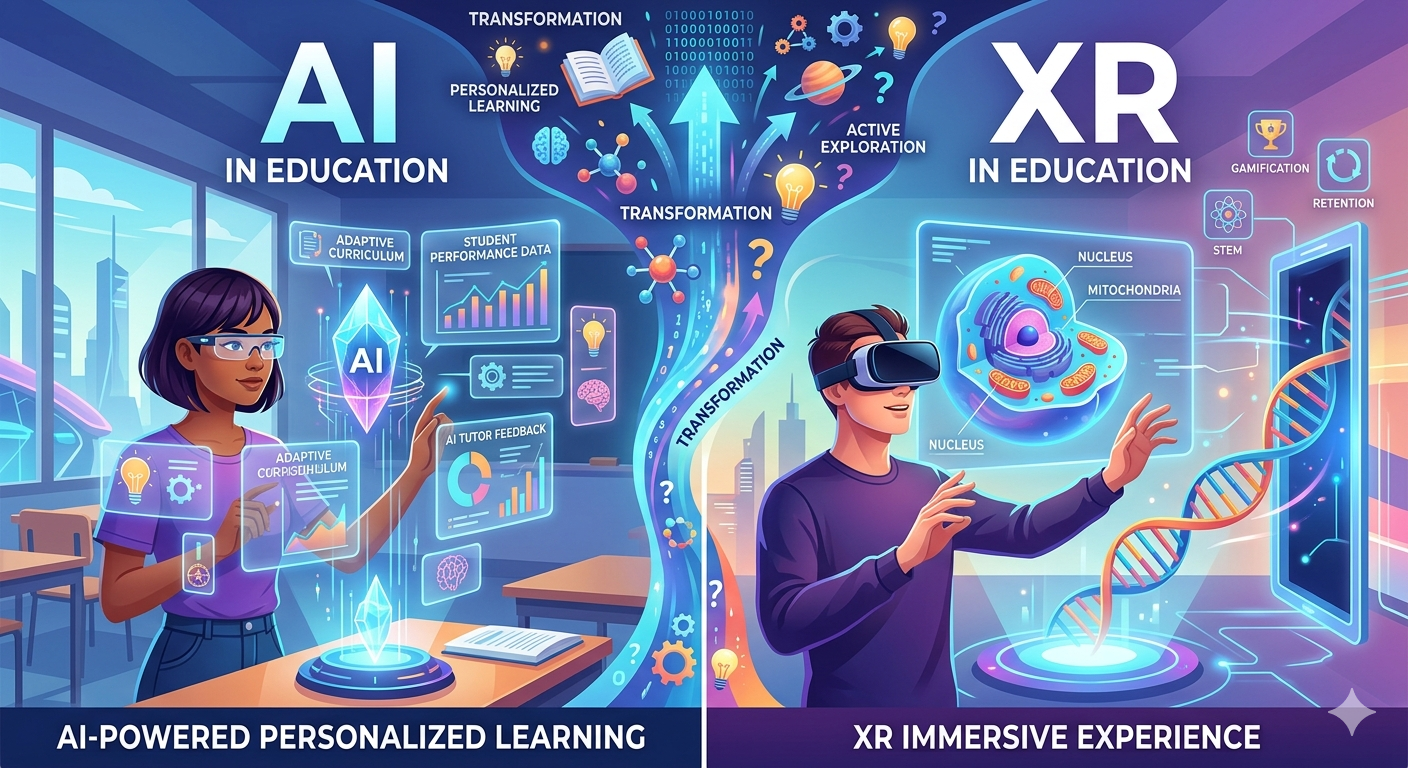
Education is undergoing a massive transformation. From Artificial Intelligence to immersive XR experiences, the way students learn is shifting from passive consumption to active exploration.
In recent years, Artificial Intelligence (AI) in Education has emerged as one of the fastest-growing areas in the learning ecosystem. AI-driven learning is rapidly gaining adoption due to its ability to personalize education and improve efficiency. Alongside AI, technologies like Extended Reality (XR) are redefining how students experience knowledge.
The Limitations of Traditional Education
The modern classroom system was originally designed during the industrial era. Its purpose was to prepare students for repetitive, process-driven jobs.
Even today, many classrooms follow the same structure:
- Students passively listen to lectures
- Learning is focused on memorization
- Assessment is based on written exams
While this model served its purpose in the past, it struggles to meet the demands of a world driven by innovation, creativity, and problem-solving.
Complex subjects such as physics, biology, and engineering require spatial understanding, which cannot be fully conveyed through textbooks and static diagrams.
Artificial Intelligence (AI) in Education
AI is transforming education by making learning more adaptive and efficient. Instead of a one-size-fits-all approach, AI enables personalized learning experiences tailored to each student.
How AI is Transforming Learning
- Adaptive Learning: Content adjusts based on student performance and pace.
- AI Tutors: Students receive instant assistance and explanations anytime.
- Automated Evaluation: Reduces teacher workload and speeds up feedback.
- Performance Insights: Identifies learning gaps using data analytics.
While AI enhances efficiency and personalization, understanding complex concepts still requires a more immersive approach. This is where XR becomes essential.
XR (Extended Reality): The Shift to Experiential Learning
XR includes Virtual Reality (VR), Augmented Reality (AR), and Mixed Reality (MR). It enables students to interact with concepts instead of just imagining them.
This transition from theoretical learning to experiential learning significantly improves understanding and retention.
Applications of XR in Education
- Biology: Explore organs and systems in 3D
- Astronomy: Experience planetary motion and space environments
- Physics: Visualize forces and motion dynamically
- Engineering: Interact with complex machines and structures
The Learning Evolution
"True understanding comes from interaction. XR transforms learning into an experience rather than just information."
Emerging Trends in Education
Along with AI and XR, several other trends are shaping the future of learning:
- Personalized Learning: Customized education pathways
- Gamification: Interactive and engaging learning methods
- Hybrid Learning: Combination of online and offline education
- STEM Education: Focus on science and technology skills
- Lifelong Learning: Continuous skill development
How DesignXR is Transforming Education
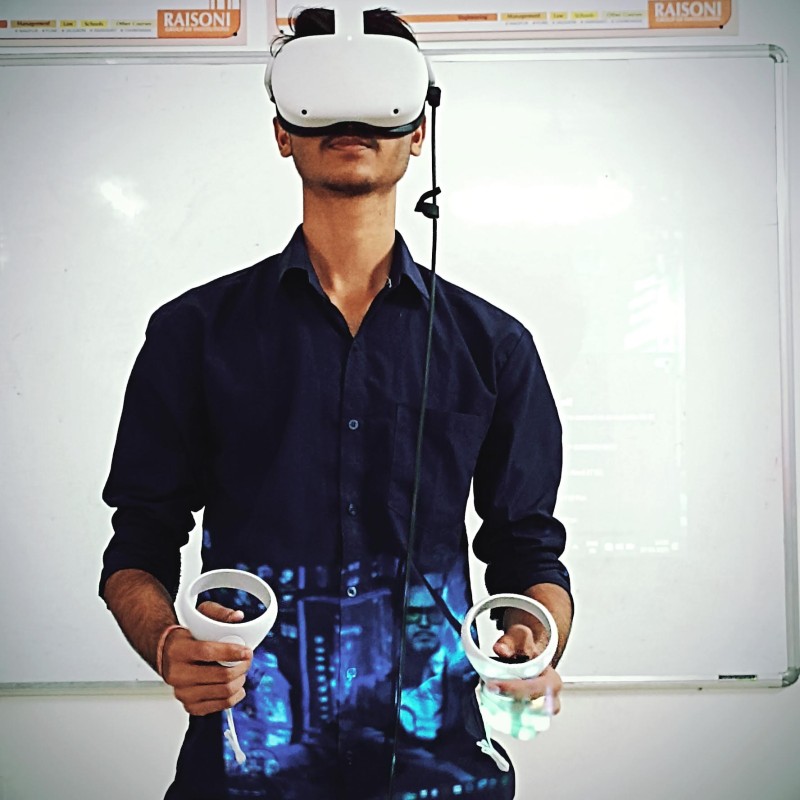
At DesignXR, we are building immersive learning environments that bridge the gap between theory and real-world understanding.
Our platform enables students to:
- Interact with 3D educational models
- Perform simulations in a safe environment
- Access immersive experiences through WebXR
By focusing on accessibility and real-world applications, DesignXR makes immersive education scalable for schools and institutions.
Frequently Asked Questions
1. What are the current trends in education?
AI, XR, personalized learning, and hybrid education models are shaping modern education.
2. How is XR used in education?
XR enables students to interact with 3D environments, improving understanding and engagement.
3. Is XR better than traditional learning?
XR enhances traditional learning by making it more interactive and immersive.
4. What is the future of education?
The future of education lies in combining AI, XR, and personalized learning technologies.
5. Why is immersive learning important?
It improves retention, engagement, and practical understanding of concepts.
Conclusion
Education is evolving from memorization-based systems to experience-driven learning. AI enhances intelligence in learning systems, while XR transforms how knowledge is perceived.
Together, these technologies are shaping a future where students actively explore and understand concepts rather than simply memorizing them.
Experience immersive learning with DesignXR: www.itsikhwal.com